|
|

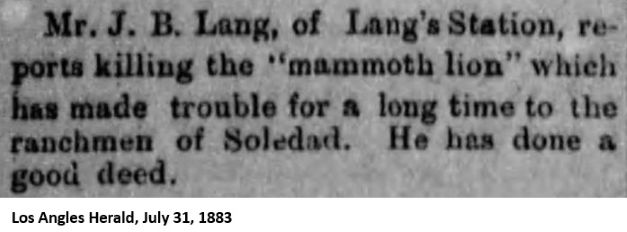
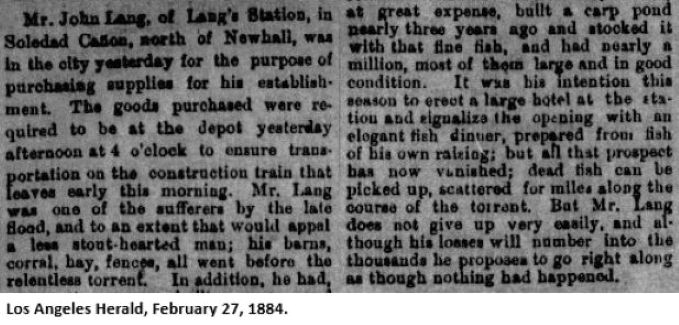
"We learn from a gentleman who came over the route last Saturday that of the 100 or more miles of railroad between Mojave and Los Angeles, not 10 miles was left intact by the storm of two weeks ago. This gentleman boarded the construction train and was forced to walk from Ravena to Lang, about 9 miles. The San Fernando Tunnel, he says, is not damaged but the approaches from both ends caved in."The Los Angeles Herald of March 14, 1884, reported that "The work in the Soledad canyon is going ahead by the aid of 1,000 men, and if no more rainstorms sweep away the new work, will be open early next week." In the midst of the rain situation, John Lang decided that it was time to build his hotel. The Los Angeles Herald of April, 10, 1884, reports that:
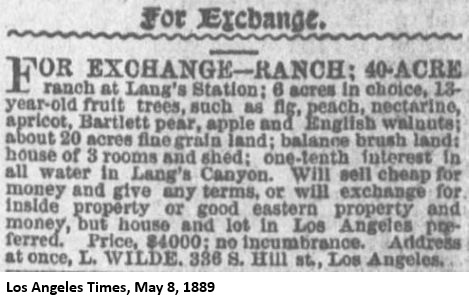
"Mr. John Lang, the projector, progenitor and proprietor of Lang's Station, was in the city yesterday, preparing for the erection of his new hotel, of two stories high, 40x80 feet, with parlors and 21 rooms, at that station, with a post office and express office. This will be a pleasant place for tourists, hunters and wood-cutters in the Soledad canyon, and visitors to the chalybeate springs in that vicinity." [Chalybeate springs are mineral springs that contain a high concentration of iron, giving the water a distinct taste and, at times, a reddish appearance.]On May 22, 1884, the Los Angeles Herald "acknowledges a call from Mr. J. Lang, of Lang's Station. He is now sending forward the lumber to build his new hotel at that place." On October 25, 1884, to help pay for the lumber, Lang borrowed $2000 from the W.H. Perry Lumber and Mill Company of Los Angeles. To secure the loan, he mortgaged his patented 160 acre ranch. On April 9, 1885, the debt was paid off.[31]
"a wonderful work of destruction had there been wrought [in Soledad Canyon] by the great freshets [floods of a river from heavy rain]. In some places both the wagon road and the railroad had been carried away, and in place of the two roadbeds a channel ten feet deep was left in place of the roads that were. A temporary track for the railway has been laid, in some cases in the channel made by the flood, while 200 men are hard at work in making a solid and substantial track at an elevation of about ten feet above the grade of the old track, where it will be out of the way of the stream which caused such great destruction. The worst damage was caused between Ravena and Lang's Station, where the ruin was complete. This track has been temporarily re-built twice, and now the third time it will be re-built in a very expensive and substantial manner, as rapidly as men and money can do it."The Herald on June 14, stated that "the track has been injured between Lang's Station and Newhall, so that the northern train did not arrive yesterday, but a large force of men is at work and it is expected that the track will be repaired so that trains will be on time tomorrow."
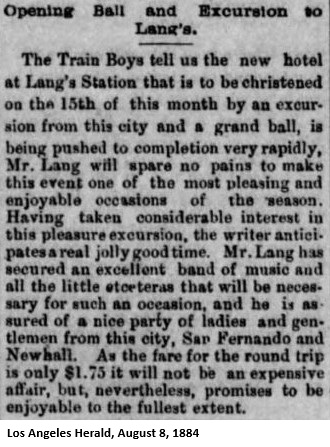
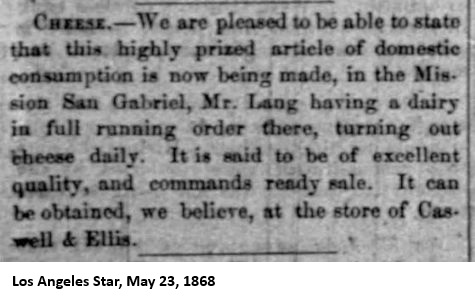
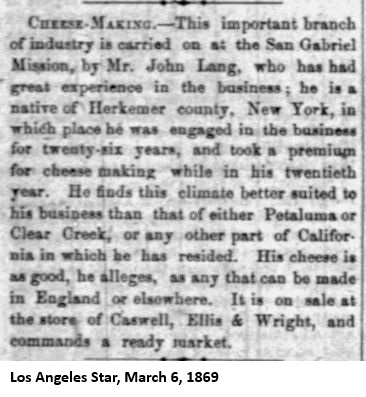
"At Lang's Station some two hundred acres are under cultivation, planted in barley, corn, fruit and vegetables, which produce the most wonderful crops. A late visit to Mr. Lang's orchard of a thousand trees, found his apple, peach, pear, quince, apricot and prune trees loaded down with fruits, until the trees had to be propped up to deep the limbs from breaking down. His fruits are of the choicest varieties and bring a big price at the ranch. His figs, nectarines, olive and walnut trees were also very fine, while the whole orchrd as well as his vines are entirely free from insects, smut or other drawbacks, to be found in lower altitudes. In his gardens can be found the choicest crisp vegetables to be found in the country, growing the year round. Cabbage, celery, carrots, chickory, corn, lettuce, potatoes, turnips, radishes, rutabegas, melons, strawberries every month in the year, as well as many other vegetables usually raised in this climate.That was quite a rosy picture painted. It is hard to believe that everything said there was true (1000 trees?), but there is no doubt that John Lang was doing well there, rain or no rain. Also, John Lang was a dairyman, so there were probably cows somewhere on his property. He was well known for his cheese making abilities.
He also has a hundred stands of bees, which are unusually profitable this year and in a very healthy condition. Mr. Lang had a large quantity of carp fish, which had also become a great source of revenue until the floods came down the canyon, from the cloud bursts last winter, and carried away several tons of his largest fish, as well as his young fish in the hatchery reservoirs. He saved a few from the floods, which are now multiplying very rapidly. Mr. Lang has lately erected a six-thousand dollar hotel at the station, which will soon be provide with bath houses, to be supplied with sulphur and pure mountain spring water from the two beautiful springs on the upper end of his ranch. As soon as the railroad company get their second side track down to accommodate the long freight, construction and passenger trains that meet here, Mr. Lang will erect a fountain and trout pond in front of his house and put out citrus and deciduous trees about his new hotel and materially improve the surrounding grounds and approaches, which will make it a great resort for invalids and other people affected with asthma and lung difficulties, as the elevation and pure ozone in this mountain fastness are said to afford almost instantaneous relief.
Lang's is destined to be a great resort, as the mountains and valleys afford plenty of game and the place is so easy of access from any direction rail. The railroad company has put up a sixty thousand gallon tank and have put a ticket office at this point. A postoffice, telegraph and express office have been established here and the people are now petitioning the Board of Supervisors to open or establish an election precinct at this place [which was done September 2]. Mr. Lang now has some ninety regular boarders [probably some in the hotel and many more camped nearby] from among the mechanics and railroad men who are engaged on the great improvement being made by the railroad company in the canyon, which we will describe in another item tomorrow. The scenery at Lang's and along up the canyon above is picturesque and grand."
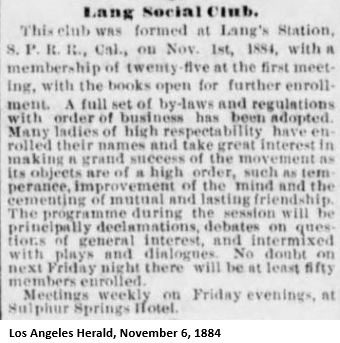
"The season so far has been the most favorable ever known in this section for planting trees, vines, shrubs and ornamental timber growth. Uncle John Lang is taking advantage of the unusually favorable season, and is now in your city purchasing a large variety of citrus and deciduous fruit trees, as well as ornamental shrubbery, to plant in the immediate vicinity of his new hotel building, erected last summer. He is also laying in agricultural implements and seed, with a view to utilize every acre of his valuable rancho. The farmers and fruit-men, as well as the bee-men, all anticipate another prosperous season and all are redoubling their efforts to make two blades grow where one grew before."This is the first time, but not the last, that the Herald prefaced "Uncle" to John Lang's name. He was a very respected and trusted man with the Herald and probably with his neighbors.
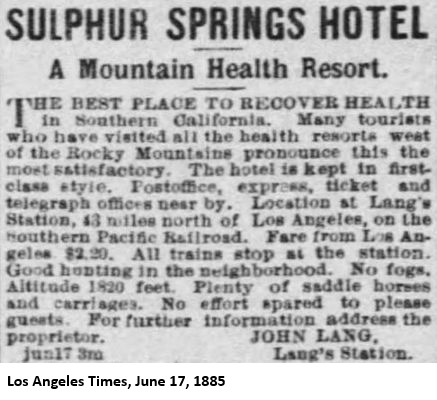
"Dr. Andrew McFarland returned a day or two ago from a visit to Lang's, a resort in the mountains north of this city and was much pleased with the place. He says the climate is undoubtedly very beneficial for invalids, particularly those suffering pulmonary and asthmatic complaints. A new hotel has lately been built by John Lang, which cost $15,000, and is beautifully furnished throughout. Mr. Lang has a fine orchard in which every kind of fruit is thriving. The sulphur springs are located in a grove of oak trees and bubble up from the base of a mountain. The doctor tested and carefully examined the water and pronounces it the finest sulphur water in the country, having an excellent medicinal effect. Langs station has a future before it as a health resort for this county."The 1885 rainy season started with plenty of rain. John's son, William, reported in November that "Rain began at 10 o'clock Sunday, the 15th inst., and up to this date seven inches have fallen, and it is still raining." By December, 10 inches of rain had been recorded.[33]
"On a recent visit to Lang's, about 40 miles north of Los Angeles, I was driven over to see a magnificent, inexhaustible ledge of gypsum. Here, said I, is an opportunity of establishing plaster-of-paris works. I inquired of the owner, Mr. Lang, if he would be willing to assist in establishing such a manufacture, and he immediately expressed his hearty concurrence in the scheme. The present is a good opportunity to engage in a profitable enterprise, where the capital outlay will be very small, and the process itself extremely simple. Mr. Lang will be very glad, I am sure, to show any capitalist or would-be investor the ledge. The present supply comes, I am informed, from New York round Cape Horn; so, surely, there must be a large margin of profit."As far as I can tell, this business was never started. The Los Angeles Times of December 5, 1885, reported that "John Lang, proprietor of the Sulphur Springs, is about to put hot and cold water baths in his hotel." The Los Angeles Herald of December 11, said that "John Lang is in the city to make preparations for bringing the water from his sulphur springs to his hotel at Lang's Station. He yesterday contracted for 5000 feet of water pipe for this object."
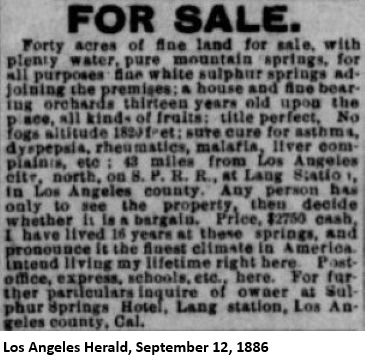
"My hotel at the present writing is surrounded with every kind of flowers, and roses that can be seen in full blossom. Also tomatoes and everything else are as fresh as in May. Altitude, 1820 feet. My bath rooms will be completely fixed up during the next month. Pipes will be laid to bring sulphur water to the hotel, and warm and cold baths will be in order in fine style. This will be a mountain health resort for tourist parties who can get around and help themselves. Nothing of a hospital nature will be allowed or practiced. Plenty of fine hunting grounds, horses, carriages, saddles, etc., on hand, and all kinds of fruits grown here at the Springs. Everything here that makes life pleasant. Extensive olive groves are being planted here this season. The intention is to make this the attractive resort of the coast. We know positively our springs are superior to anything in the line of sulphur water on this coast, and, as for climate, I can say, after sixteen years residence right here [since 1870], I have never known its equal. Many healthy people are traveling the world today who thank Lang's Station for it. Here is a school, post-office, ticket, express and telegraph office; excursion tickets on sale. Everything has been arranged to suit the convenience of all. Hotel kept on first-class principles. Charges reasonable. Very truly, John Lang, Proprietor. January 17, 1886."Meanwhile, the railroad was again suffering due to the rainy weather. The Herald of January 21, 1886: "The lines to San Francisco are all down, the whole railway and telegraph equipment from Lang's Station to Ravena having been demolished for the time being. It is estimated by the Southern Pacific Railway officials that it will be fully three weeks before the rails will be in working order to points north of Newhall. Yesterday Wells, Fargo & Co. began shipping their mail and packages to San Francisco by steamer." Los Angeles Times of January 21: "From Lang north to second crossing of creek the condition is as follows: One mile north of Lang 900 feet washed out 10 feet deep. A quarter of a mile north of this 700 feet are washed out 12 feet deep - rails and ties gone. Ninety feet of 8-foot fill at south of seventh crossing gone." Herald of January 23: "Above Lang's Station the $100,000 iron bridge is a complete wreck, part of it being carried upwards of twenty yards down stream. The wooden bridge is also wrecked, and the immense stone work made after the flood of two years ago was carried off like sand. The track in ten or twelve places is wrecked for varying from 20 to 150 yards." Finally, on January 29, the Times reported that "after the tedious ten days' blockade of railroad communication with the north, the siege is at last raised. At 4:30 p.m. yesterday the first train from the north since Monday, January 18th, pulled into the Los Angeles depot, bringing a lot of passengers, but no mail except 'pick-ups.'"
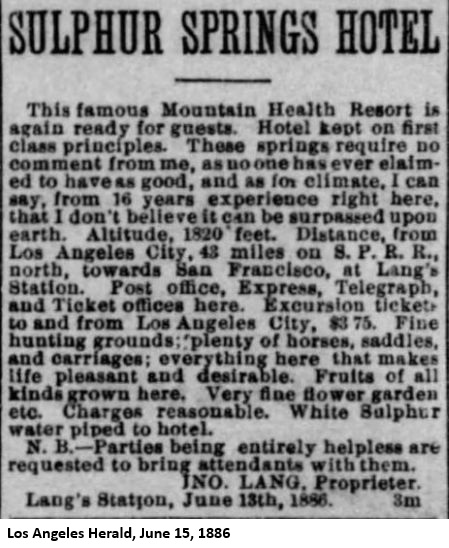
"Southern California is pre-eminently noted for the variety of its medicinal springs, both cold and hot. Besides those of a fluid nature, there are many hot mud-springs that are largely used in cases of acute rheumatism. Every county in Southern California has mineral springs of various kinds and utility. One of the most lovely and excellent groups of springs of a mineral character is the group of ten white sulphur springs at Lang, on the Southern Pacific Railroad, forty-three miles north of Los Angeles.Who could resist that?
Lang is situated in the Soledad Canon, deep in the beautiful recesses of the Sierra Madre, the charming empress of all mountain-chains. The canon was named Soledad (solitary) long before the language of Milton and Shakespeare was spoken in its lonely wilds, when deer, lions, wolves, and bears made this their chosen home...This passage through the mountains resounds to the roar of fifty trains of cars per day of the Southern Pacific system, that wind through its echoing rocks with persons and property for all parts of the earth, and under the greenwood shade sits John Lang and the wife of his youth and old age, breathing the odors of myriads of flowers and trees gathered from all parts of the United States.
This clear, mild air, with its day-breeze from the west and eastern breeze by night, and in a frostless region, is about as near perfection as can be found, and a genuine paradise for invalids, who come from far to this delightful spot to regain their vigor from the pure water of a mountain torrent, the exhilaration of almost constant sunshine tempered with breezes from the pines and cedars and fragrant shrubs, with the crystal-white sulphur fountains gushing out of the grand old mountains for the purification of the human system, a diet of venison and other game, and home-cooked food in abundance. This combination of advantages, added to fine scenery and rambles in shady canons deep and wild, with frequent trains to the city and the sea, makes Lang Sulphur Springs in Los Angeles County the banner mountain-resort for health, happiness, and comfort.
Mr. Lang, who formerly experienced periods of sickness in other localities, has now lived seventeen years at the springs without sickness of an hour's duration. The quality and virtues of the water of Lang Springs has been examined by many, including chemists and medical men. Among the recent physicians who have examined and certified to the rare virtues of this water, are Drs. Ellis, of London, England ; Powers, of Texas ; Sprague, of St. Louis ; Fonda, of Albany, N. Y. ; Barton, of New York ; Kirkpatrick, of Los Angeles ; McFarland, of Compton, Cal. ; and Dr. Turner, of New Haven, Conn. The water is clear and cold, and contains sulphur, magnesia, and iron combined in most agreeable proportions."
|
|
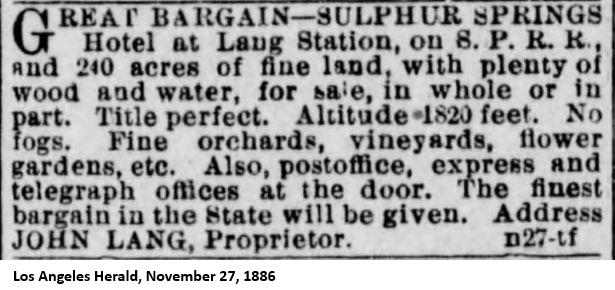
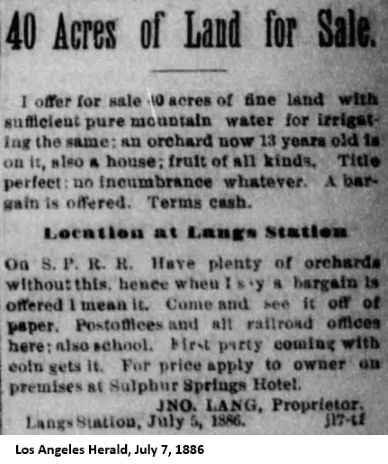
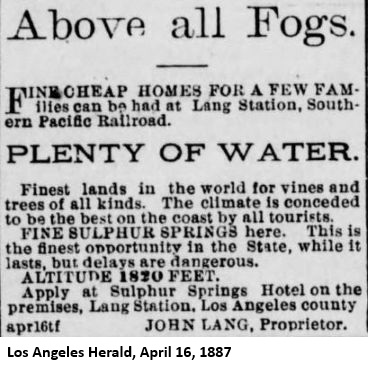
"The boom in real estate at this station is running very high at the present time. Many tranfers daily are being made. Large vineyards and orchards are being planted out, and people are flocking here from all directions. It seems as though the public have just found out that such a place as this section exists. The finest water and best climate in the world. Pure white sulphur springs. Altitude 1820 feet. Schools, post-office, express and ticket offices, finest fruit and vine land on the coast, that can, as yet, be had on cheap terms; but time is precious for those wishing homes in this locality. Land can yet be had, with plenty of water piped to the door, with a life title to same. Will sell in quantities to suit. Title perfect. For further particulars call and examine property. John Lang, proprietor of Sulphur Springs Hotel, will give particulars and show all parties around."
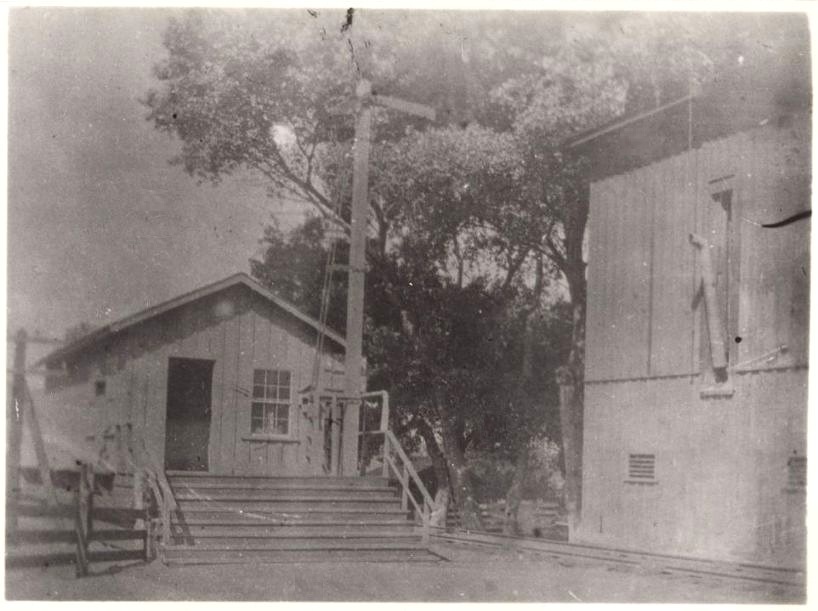
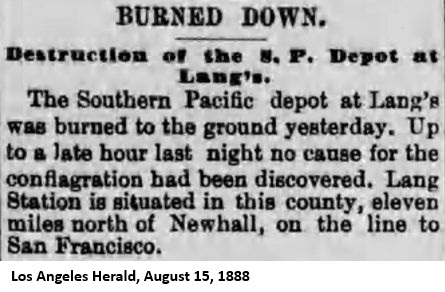
"The news from this point is that the Southern Pacific Railroad Company are making quite extensive improvements at this station. Lumber for offices, freight house, etc., is already on the ground. There were several car loads. Carpenters will be on hand in a day or so. Many people are coming in here. Mines are booming. Everybody happy."In 1884, they had put up a water tank and ticket office. There was also a section house built for the foreman and hands that worked there and maybe some storage buildings, but the newspapers did not report on those being built. In the January 13, 1888, edition of the Los Angeles Herald, Lang reports that "carpenters are on the ground building freight houses and offices." Then, on January 27th, also in the Los Angeles Herald, he said that "a fine new depot has just been completed by the Southern Pacific Railroad." This was the first depot constructed by the railroad. In the February 29th Los Angeles Herald, Lang states that "The S.P.R.R. is making many important changes by moving buildings, putting in one or two more miles of side tracks, building offices, etc."
"All minerals exist in this section. Gold, silver, iron, copper, lead and traces of coal are found in almost every direction from Lang Station. I am recorder of this mining district [Blue Ledge District], and have been for twelve years. I have many claims on record that belong to parties too poor to do anything with them. All that is needed in this district is mining men with money who will develop the mines, and not weaken if they fail to find a Comstock in five or ten feet. A man located four gold claims here only ten days ago, top rock in all assaying from $21.54 upwards, but he can't work them, having no means like the rest and all the ledges are from four to seven feet wide. Silver mines up here are in the hands of men similarly situated. Gold can be found in most any pan or shovelful of dirt in this vicinity. The time is near at hand that many a bonanza will be opened up right in this section. Capital is looking into this matter of late, and any capitalist, not a tenderfoot afraid to chance a dollar, will find his fortune buried in the earth."In July, a bed of building stone quality red sandstone was found near Lang's Station. It was "examined by experts and pronounced the finest building stone yet found in Southern California. The new quarry is the property of John Lang, who is now taking steps to have it developed."[41] A month later, Lang said that the quarry "has been leased to a heavy Los Angeles company for a term of 10 years. They have six or eight teams on the ground making first-class roads for very heavy work. Every one that has seen the rock likes it. Bidders are coming in already thick and fast."[42] Lang also reported on a very large deposit of kaolin (soft white clay that is an essential ingredient in the manufacture of china and porcelain and is widely used in the making of paper, rubber, paint, and many other products.) found near by. It was, of course, "pronounced by experts to be better than China kaolin." The deposit "is on the side of a mountain, is about 15 feet wide and has the appearance of being extensive."[43]
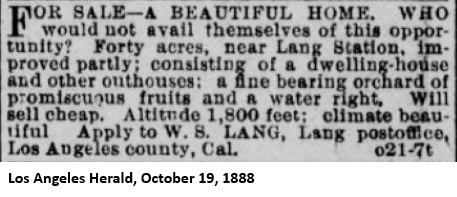
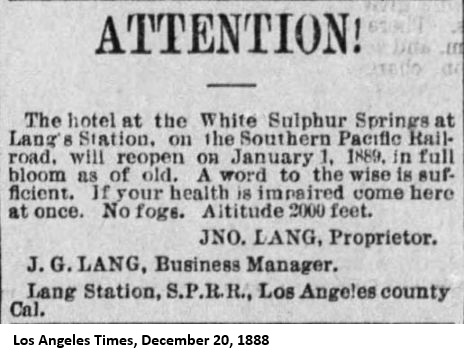
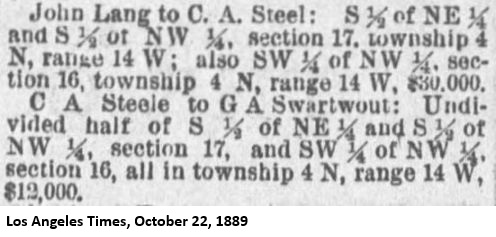
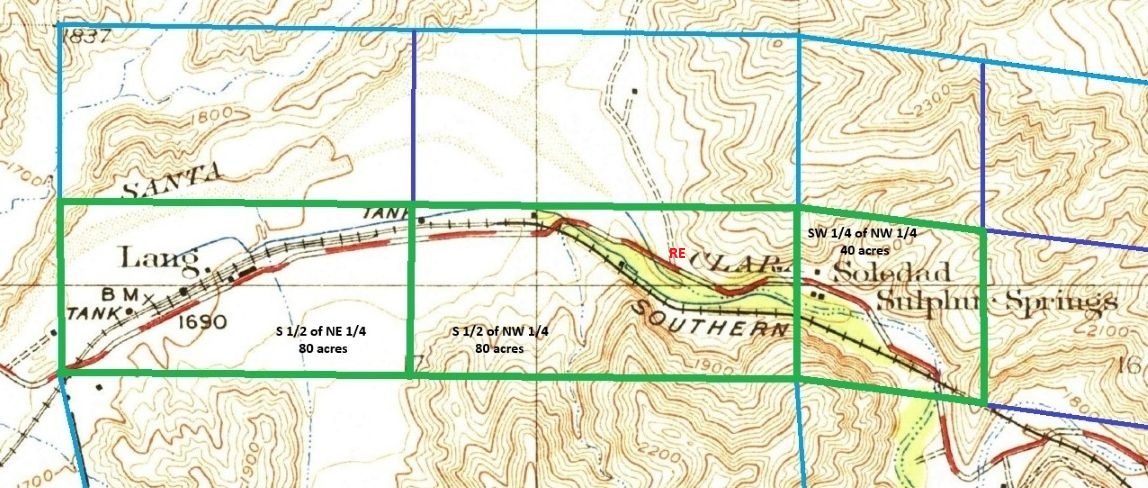
"Mr. John Lang, of Lang Station, Southern Pacific railroad, has sold his old home, where he has lived for the last twenty years, for the sum of $30,000 [yes, $30,000] - a most lovely place, at an altitude of 2,000 feet, no fogs, pure water as the earth affords, and the finest pure white sulphur springs ever known. Mr. Lang can relate some of the most remarkable cures effected at these springs that history ever recorded. The world probably affords no healthier spot. All diseases of the human family here find a remedy. Having lived for twenty-five years near these springs, I know what I am saying, and I have no interest in any way in the property, but only desire to do what good I can for the world while a little time is left me. The property has been purchased by Mr. C.A. Steele, of Los Angeles city, a gentleman of high order. A hotel, railroad offices, express, postoffice, schools, etc., are here. While Mr. Lang kept the house open for business he was thronged, the house not being one-fourth large enough.The transaction was recorded on September 16, 1889.[47] On that same day, Steele sold half interest in the property to George A. Swartwout (1850-1929) for $12,000.[48]
A Twenty-Five-Year Resident."
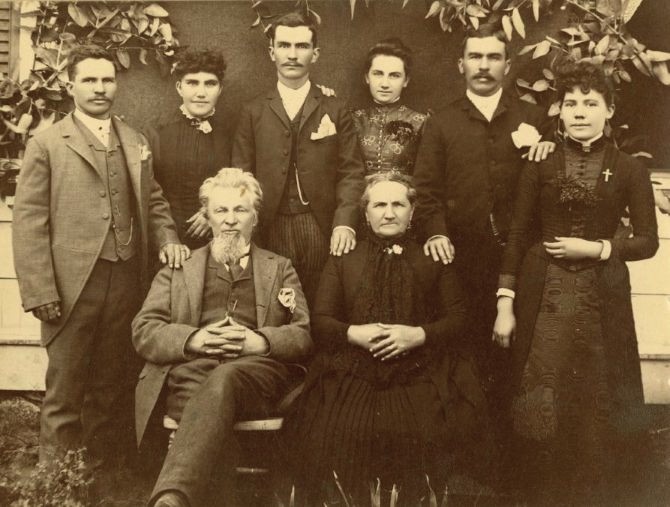
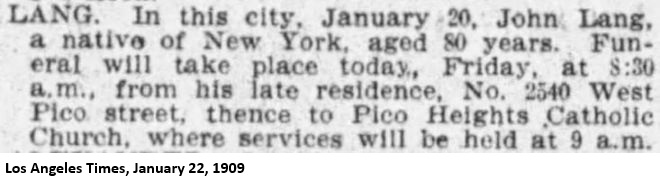
"Uncle John Lang is doing a rushing real estate business at 115 West First street. To show how great the demand is for bargains in real estate, the fact may be mentioned that a single piece of property advertised on the sixth page of the Herald brought twenty customers to Mr. Lang's office. There is a general agreement in the opinion that real estate is on the upgrade, and now is the time to invest."Once John Lang was gone, news from Lang's Station was sparse. His son John B. Lang, had not moved away with his father, like the rest of the family, but stayed on his own ranch on his 166 acre homestead[56]. He would receive a patent for it in 1898. The postmaster at Lang's Station at that time (1890-91) was Cassius H. Clayton. He leased the Lang orchard from Steele and was doing well with the fruits and bees.[57] He was also homesteading 166 acres near Lang's Station which he patented in January of 1896. The April, 1897, Pacific Bee Journal[58] reported that a law on bee adulteration (the intentional misrepresentation of honey and beeswax for profit, most commonly by diluting honey with cheaper sweeteners like corn, rice, or cane sugar syrup):
"was formulated by C.H. Clayton, of Lang, Los Angeles county, Cal., who is a regular correspondent of the P.B.J, a township justice, postmaster, and a successful manager of a few hundred stands of bees. Mr. Clayton's Senate Bill 135, was introduced by Representative Simpson, and was passed and approved by Governor Budd February 23d. This bill makes a misdemeanor of the adulteration of honey, punishable by a fine or not less than $25, nor more than $400, or imprisonment of from twenty-five to six months in the county jail, or both fine and imprisonment."1900 was an end-of-era year for Lang's Station. In January, the last Lang left the area. On January 17, 1900, John Broderick Lang sold his homestead, which he had just received a patent for two years earlier, for $540.65 to E.A. Miller of the firm of Miller & Herriott, Los Angeles real estate and loan agents.[59] J.B. and his family then moved to Simi Valley. They were listed on the 1900 US Census (taken in June) for the Simi Township.

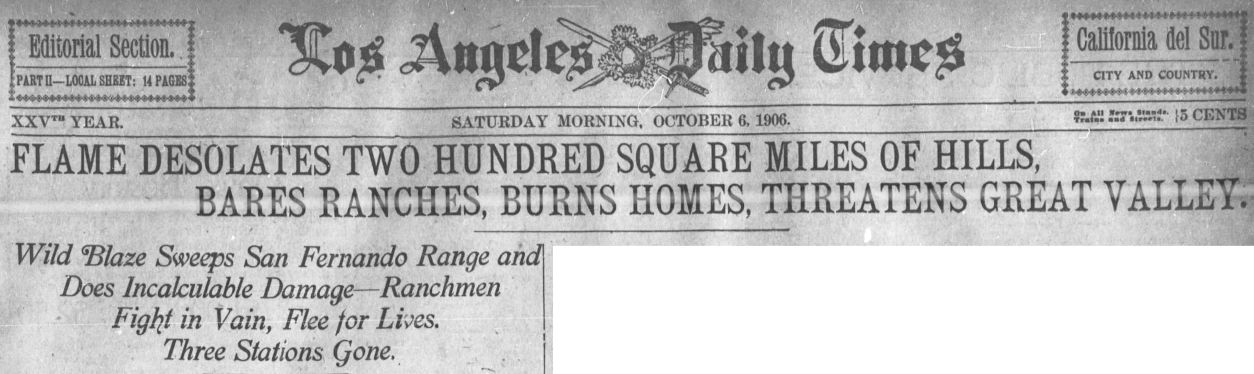
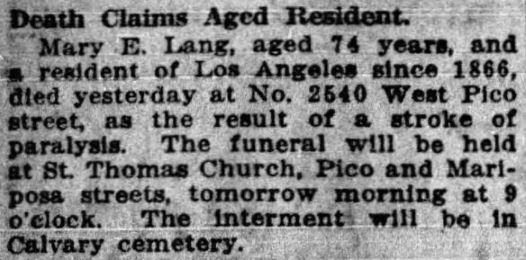
"When the old frame hotel in Lang caught from an engine spark and went up in a puff of smoke and a roar of flame, men of the town at once realized the import of the affair. While the operator at Lang was telegraphing to stations along the line for help, the fire jumped from the hotel to the railroad company's buildings; and before the message was fairly ticked off it had left the town, and was racing through the undergrowth over the adjoining hills."From the Los Angeles Evening Express of October 6:
"A new depot had but recently been constructed there [Lang], and the little hamlet was beginning to pick up with a renewed life. Across the track from the station, and the two big water tanks was a large frame hotel, and it was in this structure that the fire started. Station Agent [Howard] Slayton noticed smoke curling up from the roof and gave the alarm. The origin of the fire is not definitely known, but it is believed that either a defective flue or a spark from the chimney is responsible for the blaze that spread unchecked for many miles. 'Instantly the hotel became a roaring mass of flames,' said Slayton, in describing the conflagration. 'Night operator McReynolds, who lives in the hotel, and who sleeps late in the morning, escaped in his white robe of rest. Other inmates were eating breakfast. The house seemed to explode with fire, so dry was the structure, and these people were forced to abandon it without saving any of the contents.' C.H. Clayton of Los Angeles owned the hotel."
"Driven by a strong north wind, the hurricane of flame leaped across to the depot consumed it in a puff; slashed the supports from under the water tank, and blotted up its contents in a cloud of steam; gathered to its own the bunkhouse of a section gang and swept across the fields to the ranch of Deputy Constable Youngblood, three miles away. Five buildings, all of them small, and an olive orchard were but a morsel for the hungry flames, which raced on to the undergrowth and scattered oaks on the sides of the Soledad Canyon."
"The Western Union operator at Lang was driven from his office by the flames while telegraphing a message concerning the fire. The Southern Pacific re-established communication later, in a section house which the flames had passed by... After the destruction of the railroad property and the hotel owned by C.H. Clayton of Los Angeles, at Lang station yesterday, the flames driven by a strong north wind swept the ranch of Deputy Constable Youngblood, three miles away, consuming five small buildings and his olive orchard, then caught the undergrowth and oaks along the sides of Soledad canyon. The Southern Pacific railroad tracks were between two walls of fire for awhile and telegraph poles and wires went down."The San Bernardino County Sun of October 7 reported: "Lang station, owned by the Southern Pacific, was swept away almost immediately. The only building left to identify the station, which consisted of a hotel, depot, water tank, section gang house and handcar house, is the last named building."
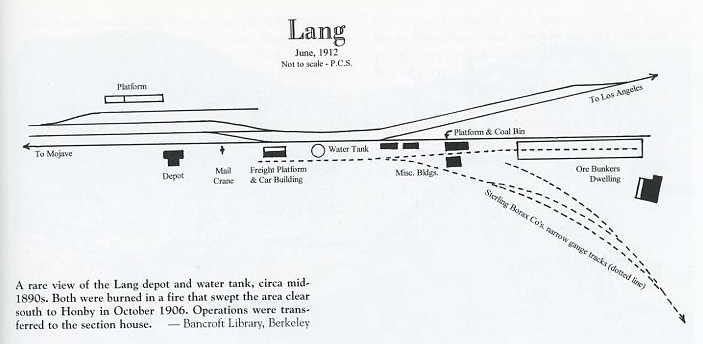

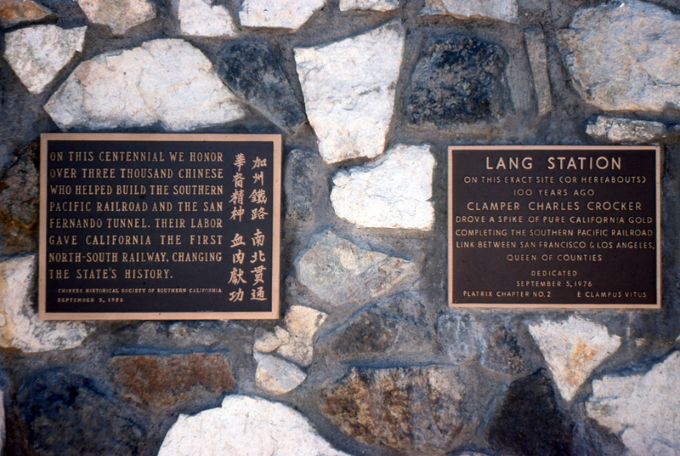
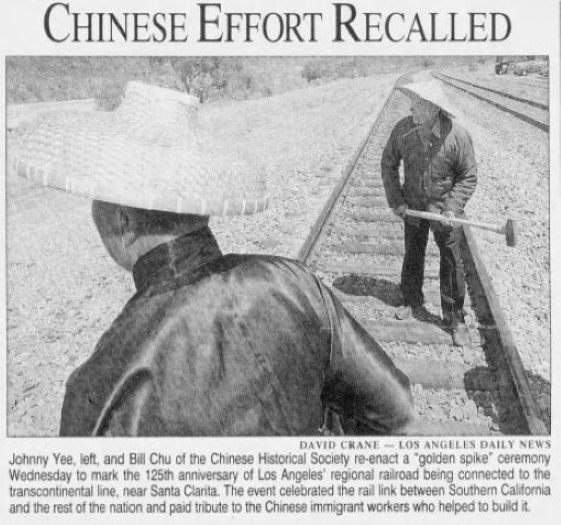
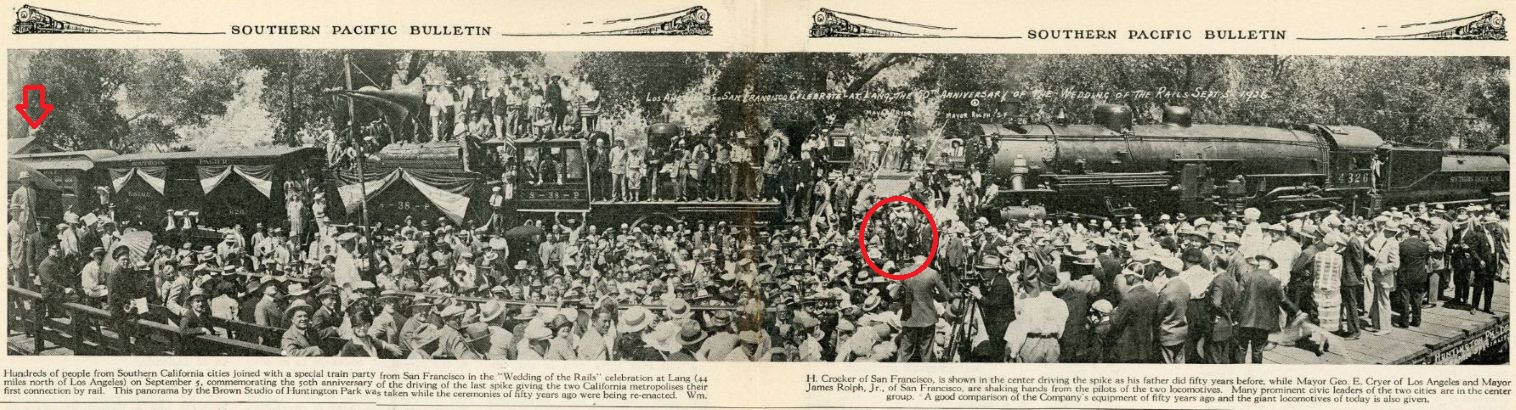
"Lang is a peculiar little station, a mere handful of railroad workers furnishing its only inhabitants. A water and a railroad siding are it chief adjuncts. At one time during the heyday of the Sterling Borax Company, a spur was built by the latter and joined the S.P. at Lang, where it was made a shipping point for both the crude and more refined ore. Nestled in the hills with trees and water near by, it presents a picture little indicating in its loneliness, and seclusion, that some day it would be aroused from a state of lethargy by thousands of visitors, with all the pomp of statesmen, to witness and celebrate the occasion when the last spike was driven in the great railroad that passes through the tiny hamlet. People living in the vicinity scarcely realize the day's significance, and wonder if their children will be present at the diamond jubilee. So on Sunday, September 5th, Lang will blossom and radiate a welcome to its guests as it has never done before. WELCOME!"There were many newspaper stories of the event including this one from the Los Angeles Daily Illustrated News of September 6 (Part 1, Part 2).

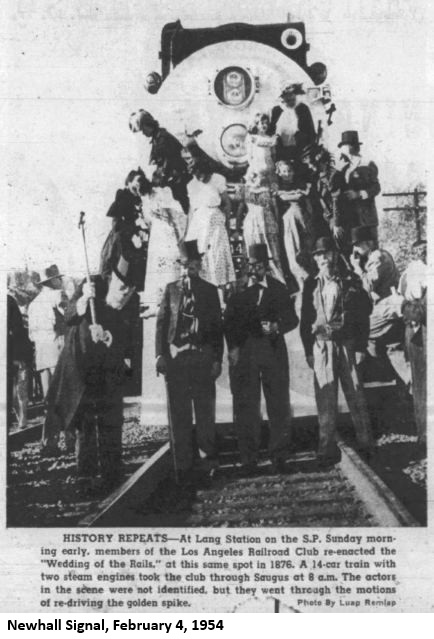
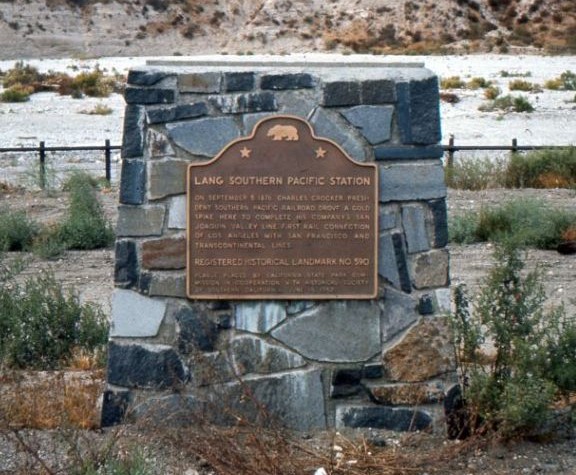
"A landmark, marking the linking of the Southern Pacific San Joaquin Valley line 81 years ago with the driving of a golden spike, will be dedicated at Lang Station in Soledad Canyon tomorrow [actually it was on the 15th]. On Sept. 5, 1876 construction crews completed the Southern Pacific San Joaquin Valley Line there and a golden spike was driven into the ties to join the rails. The original golden spike used almost 81 years ago at Lang's Station will be on public display for the first time at the Security-First National Bank, Farmers and Merchants Branch, June 17-21. It has been loaned for the week by the State Historical Society's library in San Francisco."The Newhall Signal of June 20, 1957, reported on the ceremony:
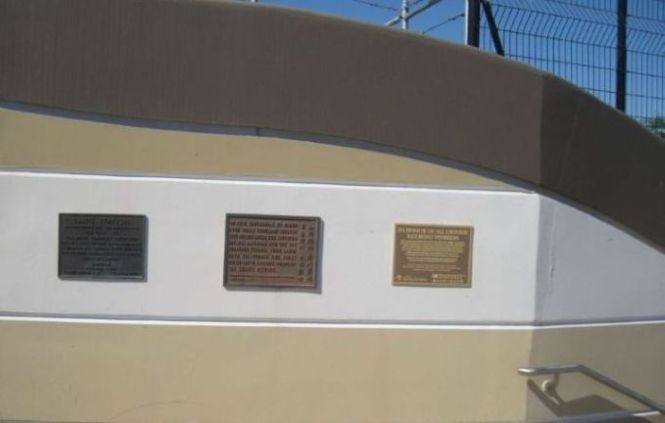
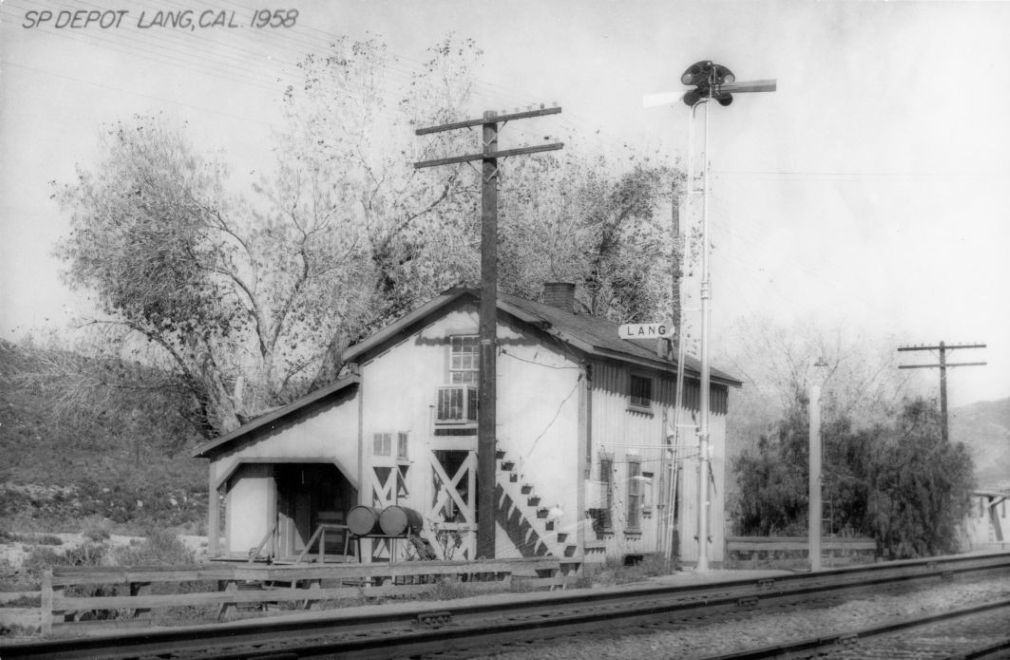
"Saturday morning [the 15th], a temporary plaque (to be replaced by one of bronze very shortly) was set upon the old railroad station at Lang, commemorating the driving of the golden spike that completed the railroad, Sept. 6, 1876, by the Historical Society of Southern California. The ceremony opened with the presentation of the old building by a representative of the Southern Pacific Railroad to the Society, the setting of the plaque designating 'California Historical Landmark No. 590', and acceptance by representatives of the Historical Society, and adjournment to Saxonia Park..."
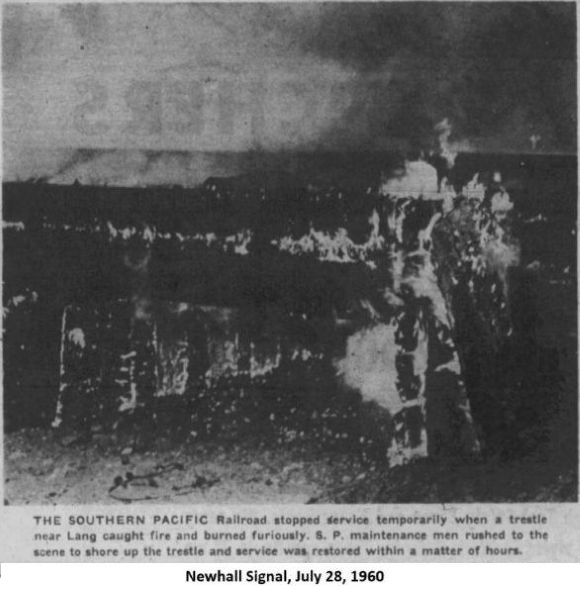
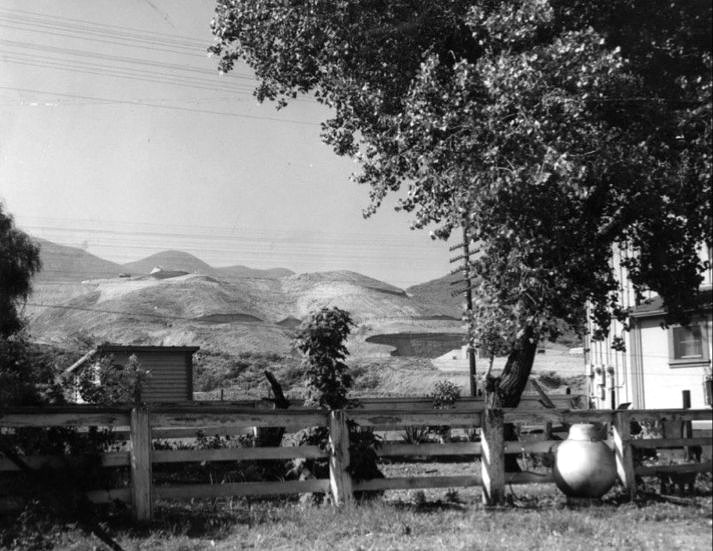
"Surging winds drove the Magic Mountain fire across Soledad Canyon in a burst of speed that blackened 11,700 acres in two hours yesterday. The Southern Pacific bridge [a 30-foot wooden trestle - see photo above] was burned at historic Lang Station. The blaze missed the station, but rushed on to Aqua Dulce Canyon, where it was moving today toward Vasquez Rocks."
"Lang Station was built at a later date [than 1876], but judging from its present condition probably not much later. A small building, it appears to be occupied as living quarters and while a bit wobbly and in need of basic repair, it is still standing. One might hope that if and when it falls over it will be in the opposite direction from the main tracks it faces to avert an even greater tragedy. Of all the railroad stations left standing in the state, this one is probably most worth saving for its historical value. So far as can be determined, no such action is envisaged. Unless interested historical-minded groups do something soon at the Lang Southern Pacific Station it looks like it will be auld lang syne..."
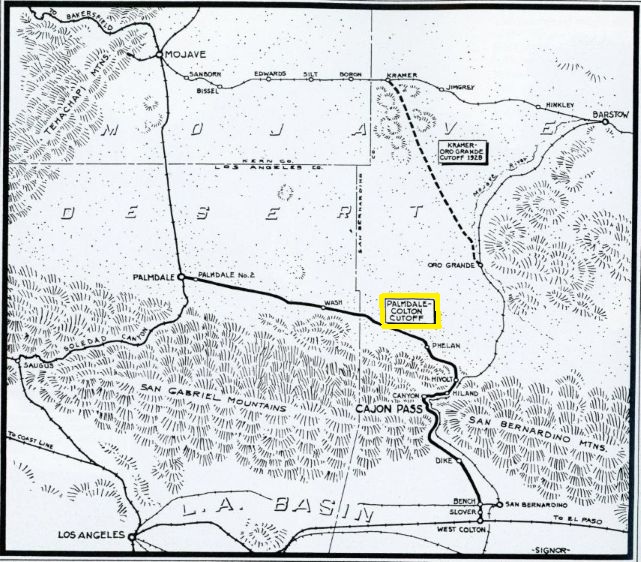
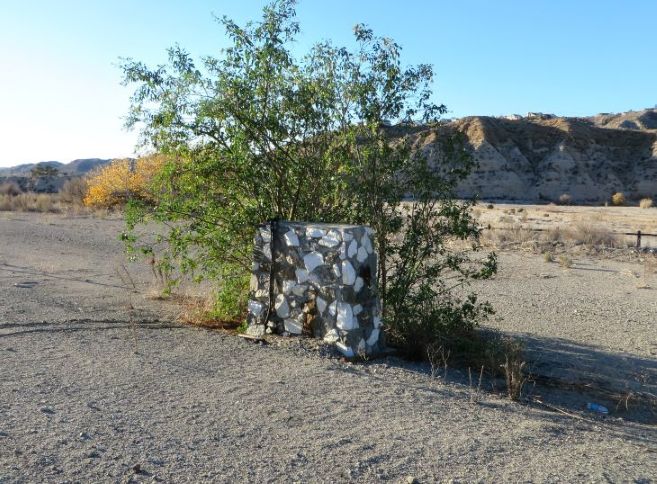
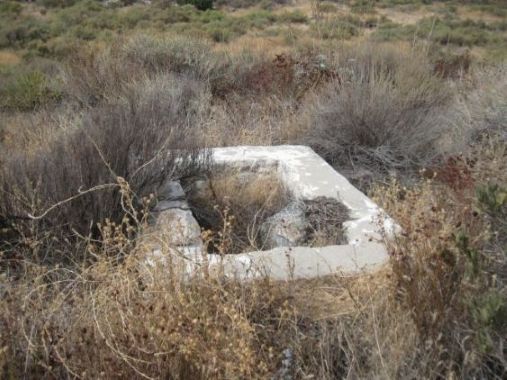
"The building was bulldozed down into the creekbed in 1971. The remains are .4 miles from Soledad Canyon Road across the railroad tracks by the river. The rusting hulk of an old Model T Ford sits on top of the remains, and down a cliff the crumpled debris of the station house sticks out of the dirt. Yellow painted boards, square nails, bottles and other relics can be found there."Reynolds had the date wrong, but that is apparently what happened. The historical society does have a few pieces of yellow sticks.